
Re-evaluating the Sustainability of Traditional Media in the Digital Transformation Era
5/28/2026
1. Introduction: The Resurgence of the Analog Billboard
Despite the rapid growth of Digital Out-of-Home (DOOH) media powered by real-time data integration, traditional analog billboards maintain a dominant market position. According to the Out of Home Advertising Association of America (OAAA) 2025 Year-End report, traditional billboards generated $6.72 billion, commandingly holding 71.1% of the total $9.46 billion OOH revenue.
While digital displays rotate multiple advertisers every 8 seconds, static analog billboards offer an unskippable 100% Share of Voice (SOV) throughout the contract duration. Amid peak digital fatigue driven by mobile feed saturation and ad-blocker usage, marketers are rediscovering the unique value of physical, unskippable media.
2. The Theoretical Framework: "Pixels vs. Pillars"
The structural advantage of traditional media over digital platforms can be defined by two distinct advertising mechanisms categorized by academic researcher Abdullahi Olarewaju Bello:
Precision Advertising (Digital): Focused on short-term, data-targeted performance metrics. Excessive personalization and intrusive algorithmic targeting can trigger consumer "persuasion knowledge" and "perceived surveillance," leading to psychological resistance and diminished long-term trust.
Presence Advertising (Physical): Characterized by high upfront costs, public visibility, and permanence. Rooted in economic Signaling Theory, investing in a premium, physical landmark signals a brand's long-term financial stability, legitimacy, and institutional scale.
The Friction Multiplier: When a consumer views a massive physical billboard, it anchors raw brand trust. When they later encounter the same brand on their mobile feeds, psychological friction is drastically reduced, significantly accelerating digital conversion rates.
3. The Priming Mechanism & High-Involvement Verticals
In the United States, major freeways in technology and corporate hubs (e.g., San Jose, Los Angeles) have become fierce battlegrounds for long-term analog billboard leases by tech firms and premium legal services (such as Morgan & Morgan). Legal services have consistently ranked as the top OOH spending category over the past decade. These high-involvement, trust-critical industries rely heavily on two core cognitive phenomena:
The Priming Effect: Repeated exposure to a permanent physical asset builds an "implicit memory" in the driver's subconscious. When a life event later triggers a need for a service (e.g., an accident), the consumer instinctively chooses the most familiar brand with the least cognitive friction.
Mere Exposure Effect: Daily exposure on standard commute routes builds automatic familiarity and authority, establishing Top-of-Mind Awareness (TOMA) without requiring aggressive direct-response messaging.
4. The Modern Tech Stack: Cross-Channel Retargeting
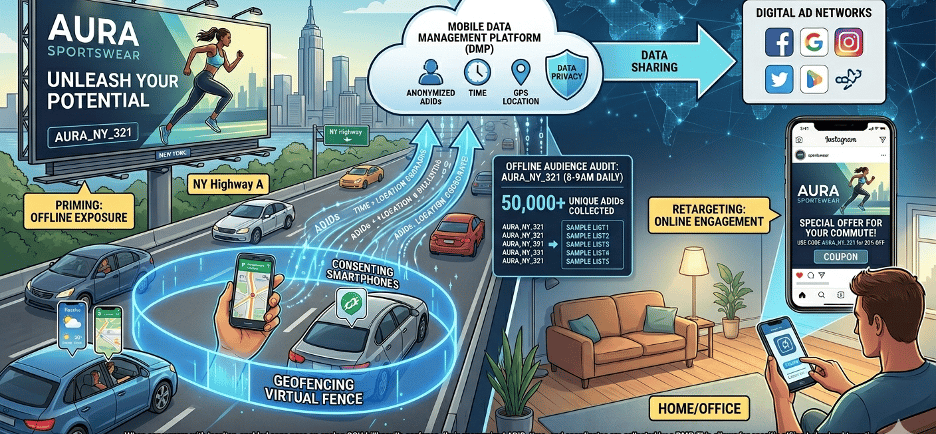
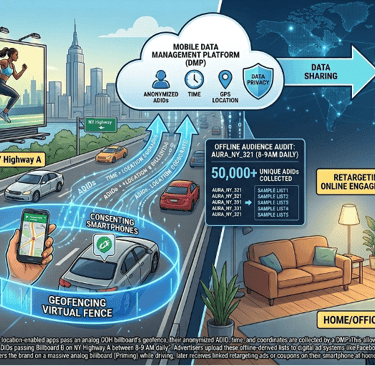
Modern analog OOH operates on a highly sophisticated, data-driven backend. By partnering with spatial and location intelligence platforms like CARTO and Kochava, agencies establish Geofencing Virtual Fences around physical billboards:
Quantitative Performance Metrics
A joint study by the OAAA and Kochava analyzing hundreds of cross-channel campaigns across 7 major industries proved that combining analog OOH with mobile retargeting generates a 7.1x spike in conversion rates (website visits, app downloads) compared to running mobile-only campaigns.
While digital-only media suffers from diminishing returns due to ad fatigue, OOH media continuously reinforces cognitive stimuli without causing consumer irritation. Audiences exposed to OOH saw a 20% increase in in-person store visits and a 14% lift in digital actions, easily outperforming the digital lift of connected TV (CTV) advertisements (~10%).
5. Conclusion: The Blueprint for Media Sustainability
The modern renaissance of traditional media demonstrates that when the entire marketing ecosystem becomes virtualized, scarcity transforms physical assets into the ultimate competitive advantage. Traditional OOH has evolved sustainably by adopting an upside-down strategic formula:
Form Factor: Remaining purely Analog and Static to maintain unskippable, physical presence and premium signaling value.
Operations: Utilizing purely Digital and Green workflows for programmatic buying, geofenced data measurement, and ecological lifecycle management (such as upcycling used billboard vinyls into commercial retail goods like Rareform bags).
By controlling a permanent monopoly over offline spatial real estate, analog billboards ensure they are not replaced by digital expansion, but rather serve as the mandatory anchor for modern, hybrid marketing playbooks.
Contact
Digital noise is louder than ever, but real-world authority cannot be ignored. If you are ready to anchor your brand in the physical landscape and deploy media strategies that command trust, permanence, and genuine human attention, let’s build together.
Subscribe our newsletter
© 2025. All rights reserved.